




How Police Use GPS Tracking: Fleet Management, Surveillance and the Law
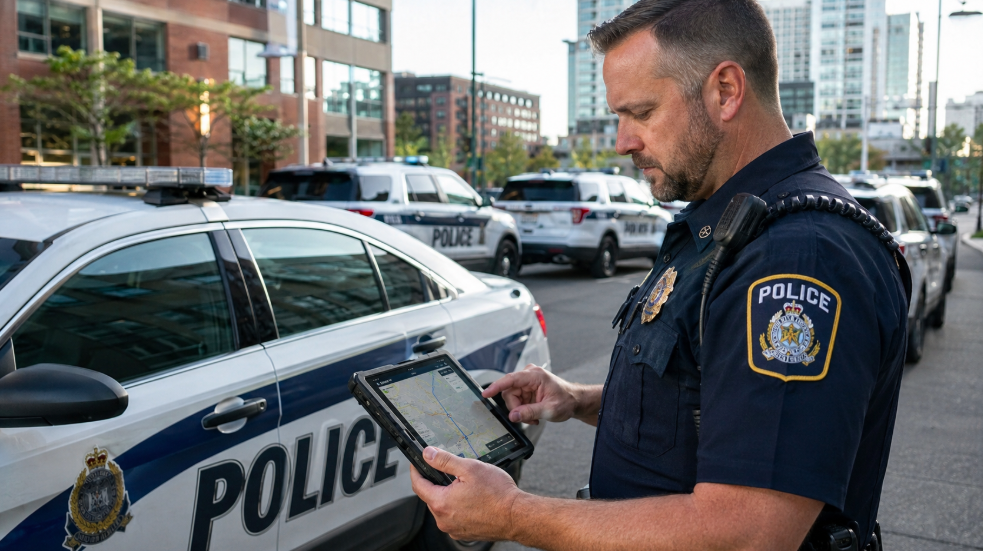
GPS tracking plays a major role in modern law enforcement. Police departments use it to manage patrol fleets, monitor suspects, recover stolen vehicles, gather evidence, and supervise offenders. Real-time location data helps officers respond faster, allocate resources more effectively, and support criminal investigations with greater accuracy.
At the same time, GPS tracking raises important legal and privacy concerns. When is a warrant required? What limits apply to police surveillance? This guide explains how police use GPS tracking, the technology behind it, and the laws that govern its use.
How Police Use GPS to Manage Their Own Fleet
Before law enforcement officers use GPS to track anyone else, they rely on GPS and vehicle tracking systems to manage their own fleet. GPS fleet tracking is now standard equipment in police departments across the country, giving dispatchers, supervisors, and commanders real-time visibility into patrol vehicles, improving dispatch accuracy, response times, and overall operational efficiency.
Closest-Car Dispatch
GPS tracking helps dispatchers see the exact location of every patrol vehicle in real time. When an emergency call comes in, they can quickly identify and send the closest available officer to the scene. Faster dispatch decisions reduce response times, improve coordination, and help officers reach people who need assistance sooner.
Zone Compliance
GPS tracking helps police departments confirm that officers are patrolling their assigned areas. If a patrol vehicle leaves its designated zone without approval, supervisors can receive an alert and review the situation in real time.
Real-Time Traffic Routing
Live traffic data helps officers avoid congestion and choose the fastest route to an incident. Reaching crime scenes, accidents, and emergencies more quickly allows police to respond more effectively when every minute counts.
Officer Safety
GPS tracking can play a critical role in officer safety. If an officer stops responding or encounters an emergency, supervisors can quickly access the officer's last known location and send assistance, reducing response times when every second matters.
Preventive Maintenance and Accountability
GPS tracking systems log vehicle mileage, idle time, speed events, and hard braking. Fleet managers use this data to schedule preventive maintenance, reducing breakdowns and costs. GPS records also provide a timestamped log of officer activity, verifying patrols, flagging unauthorized stops, and supporting internal investigations. This data helps optimize patrol coverage and improve department efficiency.
A Real-World Example
The Redmond, Washington police department joined a state-wide pilot program funded by the Washington Auto Theft Prevention Authority to test StarChase GPS dart technology. The study found that fleeing suspects typically slowed to near speed-limit speeds within two minutes of officers disengaging pursuit, making GPS tracking a safer alternative to high-speed chasing. Source: GeekWire
GPS for Suspect Surveillance

One of the most powerful and legally complex applications of GPS tracking is covert surveillance of suspected criminals. Known as a "slap-and-track" operation, law enforcement officers attach a small GPS tracking device to a suspect's vehicle and monitor its movements remotely, often for days or weeks. When discreetly installed in a wheel well or under a bumper, these devices are virtually undetectable.
Why GPS Surveillance Beats Physical Tailing
Traditional surveillance requires a team of officers, multiple vehicles, and around-the-clock coordination and even then, suspects can spot a tail and change behavior. GPS tracking eliminates most of that friction, making it a far more practical tool for long-term investigations.
- A single device can monitor a suspect's movements 24/7 without a follow vehicle on the road
- Law enforcement officers avoid the accidents and liability of high-speed pursuits
- Location data builds a detailed pattern of life, who a suspect meets, where they go, and when, yielding valuable insights for investigators
- GPS logs are admissible as digital evidence in court if collected lawfully, helping agencies charge and convict criminals more effectively
- The ability to monitor remotely allows a smaller team to conduct surveillance that would otherwise require a much larger deployment
How Police Use GPS Darts to Stop High-Speed Chases
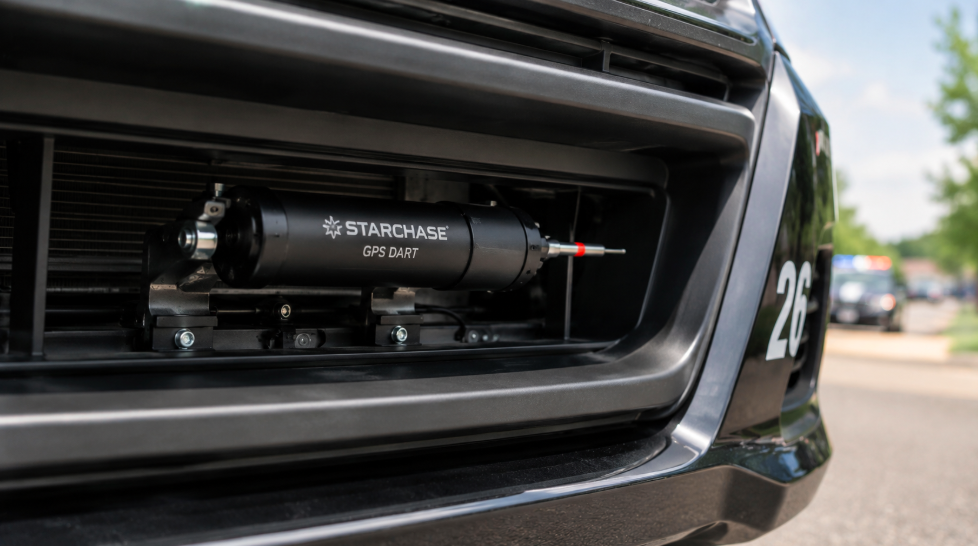
One of the most innovative GPS tracking tools in modern law enforcement is the GPS dart launcher, a cannon mounted to the front grill of a police car that fires adhesive GPS projectiles at fleeing vehicles during a pursuit. When a suspect tries to flee, instead of engaging in a dangerous high-speed chase, the officer fires a dart that sticks to the rear of the target vehicle. Officers can then slow down and disengage, monitoring the car's location in real time from a safe distance, then coordinating a controlled stop when conditions are safer for everyone involved.
Departments that have adopted GPS dart systems report significant reductions in pursuit-related accidents, improving safety for officers, suspects, and bystanders alike. For agencies that regularly deal with vehicle pursuits, the technology has been a game changer, allowing officers to track fleeing vehicles from a safe distance while reducing the risks associated with high-speed chases. It is one of the clearest examples of how GPS technology can protect lives while still helping law enforcement locate and apprehend criminals effectively.
GPS for Evidence Gathering and Asset Tracking
GPS isn't only useful for tracking a suspect's vehicle, it's also a powerful evidence-gathering tool when applied to cargo, packages, and other assets. This is where GPS tracking systems start to function more like the tools used in commercial asset tracking, adapted for law enforcement investigations.
Tracking Suspicious Cargo
Law enforcement officers investigating smuggling, trafficking, or theft rings can place a GPS device inside a package, shipment, or vehicle load. As the cargo moves through the supply chain, every location, stop, and handoff is logged. This data creates a chain of custody and a documented travel history that prosecutors can present in court to identify networks and charge participants.
Recovering Stolen Vehicles
Many modern vehicles include factory-installed GPS systems that law enforcement can activate remotely after a theft report is filed. Officers coordinate with manufacturers to obtain real-time location data and guide police cars directly to the stolen vehicle, often recovering it before the owner even completes a report.
Additionally, agencies use GPS decoy bait operations, planting a tracker inside a decoy package or vehicle left in a theft-prone area. When the bait is stolen, the GPS tracking device activates and leads police directly to the suspect. It's a simple, highly effective technique for catching repeat offenders and identifying organized theft rings.
Tracking Evidence Stored in Lockers
Some police departments have extended GPS tracking to evidence management. GPS-enabled tags on specific high-value items in evidence storage help departments monitor whether items remain in their designated location, a safeguard against tampering or unauthorized removal that also supports chain-of-custody documentation.
GPS Monitoring for Parolees and Offenders
Electronic monitoring via GPS ankle bracelets is now standard practice for managing parolees, those on house arrest, and high-risk offenders awaiting trial. Rather than requiring a parole officer to physically monitor every released person, GPS technology enables continuous supervision of many individuals simultaneously, a crucial efficiency gain for agencies managing large caseloads.
According to the Bureau of Justice Statistics, an estimated 125,000 to 150,000 individuals are supervised through electronic monitoring on any given day across the United States. GPS monitoring costs just $4 to $15 per day, compared to $100 to $150 per day for incarceration, making it one of the most cost-effective supervision tools in the criminal justice system. (Source: Ankle Monitor / Bureau of Justice Statistics)
How GPS Parole Monitoring Works
- Setup: Officers or court officials input approved locations, home, workplace, rehabilitation center, as geofence coordinates into the monitoring system
- Continuous reporting: The ankle bracelet reports the wearer's location at regular intervals, typically every few minutes, giving supervisors real-time tracking capability
- Automated alerts: If the individual enters a restricted zone or leaves an approved area, the system sends an automatic alert to the supervising officer, no manual check required
- Violation logging: Every breach is logged with time, date, and precise location, providing clear, court-ready documentation if revocation proceedings are needed
This system allows supervision of far more individuals than physical monitoring would ever permit, freeing officer capacity for active law enforcement duties while keeping community accountability high. It's also significantly less expensive than incarceration, making it a practical tool for courts managing non-violent offenders.
The Legal Framework: What the Law Actually Requires
GPS tracking by law enforcement sits at the intersection of powerful investigative capability and fundamental constitutional rights. The rules haven't always been clear, they've been shaped case by case, through challenges that reached the highest courts in the country. Understanding that evolution is essential for anyone working in, or affected by, law enforcement surveillance.
Key Court Cases That Shaped Police GPS Use
The earliest major ruling on GPS-style tracking gave law enforcement significant latitude. The Supreme Court held that limited location monitoring when combined with physical visual surveillance did not constitute a search requiring a warrant.
At the time, tracking technology was primitive and short-range. Courts treated it more like following someone in public than conducting a search. That permissive standard held for years, until the technology outpaced the legal framework that governed it.
Everything changed when the Supreme Court ruled unanimously that attaching a GPS device to a vehicle and monitoring its movements constitutes a "search" under the Fourth Amendment.
The case involved a drug trafficking suspect whose vehicle was tracked for 28 days without a valid warrant and the Court made clear that law enforcement could no longer treat long-term GPS surveillance as a warrantless right. This ruling fundamentally restructured how agencies approach GPS-based investigations, and it remains the controlling precedent today.
Shortly after Jones, the Third Circuit Court of Appeals took the ruling further. FBI agents had placed a GPS tracker on the Katzin brothers' vehicle without obtaining a warrant and the court held that the evidence gathered was inadmissible as a result.
The case became a direct, concrete example of what happens when procedure fails: a potentially strong prosecution collapses at the point of evidence suppression. For law enforcement agencies, Katzin sent a clear operational message, no warrant, no case.
The Supreme Court's recent ruling extended Fourth Amendment protections to digital location tracking, requiring a warrant to access extensive cell-site location data from phones. This decision recognizes that prolonged digital tracking reveals private life details, and law enforcement can no longer access phone location records without proper legal authorization.
The Three Warrant Exceptions Law Enforcement Can Use
While a warrant is the default requirement for GPS surveillance, courts have recognized specific exceptions where warrantless tracking may be permitted:
| Exception | When It Applies | Key Limitation |
|---|---|---|
| Border Entry | Vehicles entering the U.S. from another country at a port of entry | Federal agents only; monitoring capped at 48 hours before a warrant is needed |
| Public Safety Emergency | Active, immediate threat to human life requiring real-time tracking | Narrow scope; cannot be used preemptively or for general investigations |
| Consent | The subject voluntarily agrees to GPS monitoring | Consent must be knowing and voluntary, not coerced or implied |
The Probable Cause Problem
Here's the practical tension law enforcement agencies face: GPS tracking is most valuable in the earliest stages of an investigation, before enough evidence exists to establish the probable cause required to obtain a warrant.
This creates a real operational dilemma. Investigators know that GPS could reveal the connections they need to charge criminals, but legally they must already have significant evidence before they can deploy the tracking system. Agencies navigate this carefully, often working with prosecutors to build sufficient probable cause through other investigative methods before installing a device on a suspect's vehicle.
What Happens When Evidence Is Collected Without a Warrant?
Under the Fourth Amendment's exclusionary rule, evidence obtained through an illegal search, including GPS tracking without a required warrant, can be suppressed. That means it cannot be presented at trial. In cases where GPS data forms the foundation of a prosecution, a successful suppression motion can result in dismissed charges, even against serious offenders. The installation itself becomes the issue and courts have made clear that proper procedure is not optional.
GPS Tracking Use Cases: A Side-by-Side Comparison
| Use Case | Warrant Required? | Primary Benefit | Key Risk / Limitation |
|---|---|---|---|
| Fleet / patrol car management | No | Faster response, officer accountability, efficient operations | Officer resistance to being monitored |
| Suspect vehicle surveillance | Yes (in most cases) | Long-term surveillance without detection; strong court evidence | Evidence inadmissible without warrant; cases can collapse |
| GPS dart / pursuit deterrence | No (exigent circumstances) | Reduces high-speed chase injuries; allows safe tracking | Limited range; dart must make contact with fleeing vehicle |
| Cargo / package tracking | Context-dependent | Chain of custody; identifies trafficking networks | Requires careful placement and operational coordination |
| Stolen vehicle recovery | No (owner consent / factory system) | Fast recovery; accurate real-time location data | Only works if a device or system was pre-installed |
| Parolee / offender monitoring | No (court-ordered) | Continuous supervision at scale; automated alerts | Relies on device integrity, battery life, and network coverage |
Privacy Rights and the Public Interest
The tension between effective law enforcement and individual privacy is real and courts have consistently held that both matter. Most people consider their vehicle a personal space. The ability to move freely, without continuous government surveillance, is a value embedded in the Fourth Amendment's protections against unreasonable searches.
At the same time, GPS tracking technology has helped law enforcement officers convict violent offenders, recover stolen vehicles and cargo, and protect communities in ways that weren't previously possible without vastly larger deployments of personnel. The benefits to public safety are concrete and documented.
The legal framework that has emerged, warrants required, exceptions carefully defined, evidence subject to challenge, reflects an ongoing effort to balance these competing interests. As GPS tracking devices become smaller, cheaper, and more capable, those tensions will only intensify. Courts will continue to shape the rules, and law enforcement agencies will continue to adapt.
Conclusion
GPS tracking has become an indispensable tool in modern law enforcement, helping police departments manage their fleets more effectively, conduct suspect surveillance more safely, gather admissible evidence more reliably, and monitor parolees and offenders at scale. For agencies committed to operating efficiently and serving their communities, the global positioning system delivers capabilities that simply weren't possible a generation ago.
But that capability comes with real legal boundaries. The Fourth Amendment applies. Warrants are required. Evidence collected without proper authorization can and does get thrown out. Law enforcement agencies that understand and respect those boundaries use GPS tracking to its full potential without jeopardizing their cases or exposing their departments to legal challenge.
For individuals seeking GPS for personal use and businesses that need reliable tracking technology, BrickHouse Security offers professional-grade solutions backed by real human support and proven field performance.
Frequently Asked Questions
How does real-time tracking help police respond to emergencies?
Can GPS evidence be used in court?
What is a slap-and-track operation?
How do GPS ankle monitors work for parolees?
What happens if police use GPS tracking without a warrant?
Posted by Kellie Kendall on Mar 24th 2025