




Apple AirTag vs. GPS Tracker: Which One Actually Protects Your Car?
Quick Answer: An Apple AirTag costs $29 with no monthly fee, but it is not a GPS device. It relies on nearby iPhones to crowdsource its location, which means it cannot provide real-time tracking, works poorly in rural areas, and alerts thieves to its presence through Apple's anti-stalking notifications. A dedicated GPS tracker costs $29 to $99 plus $15 to $35 per month, but it connects directly to satellites and cellular networks to deliver real-time location updates from anywhere with cell coverage, instant motion and geofence alerts, speed monitoring, and trip history. For car theft protection, teen driver safety, or tracking a loved one, a GPS tracker is the only reliable option.

Why This Comparison Matters in 2026
Apple sold over 100 million AirTags within two years of launch, and many buyers assumed they could use one to protect their car from theft. Social media is filled with stories of people taping an AirTag under their seat or inside a wheel well, hoping it would help police recover a stolen vehicle. Sometimes it works. More often, it does not.
The confusion is understandable. Both AirTags and GPS trackers show a dot on a map. But the technology behind that dot is completely different, and those differences determine whether you actually get your car back or just watch a dot disappear.
At BrickHouse Security, we have helped families and individuals protect vehicles, loved ones, and personal property since 2005. We regularly hear from customers who tried an AirTag first and switched to GPS after a bad experience. This guide explains exactly why that happens and helps you choose the right tool from the start.
How Apple AirTags Actually Work
An AirTag does not contain a GPS chip. It broadcasts a short-range Bluetooth signal that can be detected by nearby Apple devices (iPhones, iPads, Macs) within approximately 30 to 50 feet. When a passing iPhone detects your AirTag's signal, it anonymously relays the AirTag's location to Apple's Find My network, which then updates the map in your Find My app.
This system is called "crowdsourced tracking." Your AirTag is entirely dependent on other people's phones to tell you where it is. In a busy city with iPhones everywhere, this can work reasonably well for finding lost keys or a misplaced bag. In a suburban parking lot at 3 AM when your car is being stolen, or on a rural highway where the thief is driving, the chances of consistent updates drop dramatically.
What AirTags Can Do
- Show approximate location when near other Apple devices
- Play a sound within Bluetooth range to help you find a nearby item
- Use Ultra-Wideband (UWB) precision finding on iPhone 11 and newer within close range
- Alert you when you leave an item behind (Notify When Left Behind feature)
- Last approximately one year on a replaceable CR2032 battery
What AirTags Cannot Do
- Provide real-time, continuous location updates
- Track movement in areas without nearby iPhones
- Send instant alerts when your car starts moving
- Report speed, direction, or driving behavior
- Create geofence boundaries with entry and exit alerts
- Store trip history or route data
- Work with Android phones or non-Apple devices for tracking
How GPS Trackers Work
A dedicated GPS tracker contains an actual GPS receiver that communicates directly with satellites orbiting Earth. It calculates its precise position (accurate to within 6 to 15 feet) and then transmits that location over cellular networks (4G LTE) to a tracking platform you access from your phone or computer.
This means a GPS tracker works independently. It does not need other people's phones nearby. It does not need Bluetooth range. It reports its location from anywhere with cellular coverage, which in the United States covers over 99% of the population and the vast majority of roads and highways.
What GPS Trackers Can Do
- Report real-time location every 5 to 60 seconds, depending on your plan
- Send instant motion alerts the moment your parked car starts moving
- Create geofence zones and alert you when the tracker enters or exits them
- Monitor speed and send alerts when a threshold is exceeded
- Store complete trip history with routes, stops, and timestamps
- Work anywhere with cellular coverage, regardless of who is nearby
- Support multiple users viewing the same tracker (family sharing)
- Include panic buttons for emergency situations
Side-by-Side Comparison Table
| Feature | Apple AirTag | GPS Tracker (BrickHouse) |
|---|---|---|
| Technology | Bluetooth + UWB (crowdsourced) | GPS satellites + 4G LTE cellular |
| Tracking Range | Only works near other iPhones | Anywhere with cell coverage (99%+ of US) |
| Update Frequency | Sporadic (minutes to hours to never) | Every 5 to 60 seconds, continuously |
| Real-Time Tracking | No | Yes |
| Motion Alerts | No | Yes, instant notification |
| Geofencing | No | Yes, unlimited zones |
| Speed Alerts | No | Yes, customizable thresholds |
| Trip History | No | Yes, full route replay |
| Device Cost | $29 (one-time) | $29 to $99 (one-time) |
| Monthly Cost | $0 | $17.99 to $34.99 |
| Battery Life | ~1 year (CR2032 coin cell) | 2 to 6 weeks (rechargeable) or unlimited (hardwired/OBD) |
| Anti-Stalking Alerts | Yes (alerts nearby iPhones and Android) | No unwanted alerts to third parties |
| Works With | Apple devices only | Any smartphone, tablet, or computer |
| Best For | Keys, wallets, luggage, backpacks | Cars, motorcycles, teens, elderly, valuables |
The Anti-Stalking Problem: Why AirTags Alert Thieves
In 2022, Apple introduced anti-stalking measures that notify iPhone and Android users when an unknown AirTag has been traveling with them. This was a necessary safety feature to prevent misuse, but it creates a serious problem for anyone using an AirTag for theft protection.
If someone steals your car with an AirTag hidden inside, their iPhone will eventually alert them: "AirTag Found Moving With You." At that point, the thief knows exactly what to look for. They can find the AirTag, remove the battery, and your tracking is over. Research from Northeastern University found that these alerts can take hours to appear, giving thieves plenty of time to move the vehicle far from its original location before the alert even triggers.
Dedicated GPS trackers do not broadcast Bluetooth signals and do not trigger any alerts on nearby phones. A properly installed GPS tracker remains completely invisible to a thief, continuing to report the vehicle's location silently until it is recovered.
Real-World Scenarios: When Each Device Makes Sense
Scenario 1: Your Car Is Stolen at Night
With an AirTag: You wake up, open Find My, and see the last known location from 6 hours ago when a neighbor's iPhone happened to pass by. The car has since moved, but no iPhones have been near it in the industrial area where it is now parked. You have no current location to give police.
With a GPS tracker: At 2:47 AM, you receive a motion alert on your phone: "Your vehicle is moving." You open the app and watch the car's location update every 10 seconds as it drives away. You call 911 and provide real-time coordinates. Police intercept the vehicle 12 minutes later.
Scenario 2: Monitoring Your Teen Driver
With an AirTag: You can see your teen's approximate location when they happen to be near other iPhones. You cannot see how fast they are driving, whether they arrived at school, or if they left the approved area. You get no alerts.
With a GPS tracker: You receive a geofence alert confirming your teen arrived at school. Later, you get a speed alert showing they hit 52 in a 35 zone. You have data for a calm coaching conversation that evening. Your teen also has app access and is building awareness of their own habits.
Scenario 3: Keeping Tabs on an Elderly Parent
With an AirTag: Your parent carries it in their pocket, but if they wander into a park or quiet neighborhood with few iPhone users, you lose visibility entirely. No alerts, no breadcrumb trail, no way to find them quickly.
With a GPS tracker: You set a geofence around their home and neighborhood. The moment they leave that boundary, you receive an alert with their exact location. You can follow their movement in real time and reach them quickly, or share coordinates with first responders.
When an AirTag Is the Right Choice
AirTags are genuinely useful for specific, low-risk situations:
- Keys and wallets: The most common use case. If you misplace them in your house or office, the precision finding feature helps you locate them within inches.
- Luggage at airports: Airports are dense with iPhones, so AirTags update frequently. They are excellent for confirming your bag made it onto the plane or tracking a lost suitcase.
- Backpacks and purses: For everyday items you might leave behind at a restaurant or gym, the "Notify When Left Behind" feature is genuinely helpful.
- Pets in urban areas: In a city with dense iPhone coverage, an AirTag on a collar can help locate a lost pet. (Though a GPS pet tracker is still more reliable.)
The common thread: AirTags work best for low-value items in high-density areas where the consequence of failure is inconvenience rather than financial loss or personal danger.
When You Need a GPS Tracker Instead
A dedicated GPS tracker is the right choice whenever the stakes are high:
- Car theft protection: Real-time tracking, motion alerts, and no anti-stalking notifications mean your tracker keeps working silently even after a theft.
- Teen driver monitoring: Speed alerts, geofencing, and trip history give you the data to coach safe driving habits.
- Elderly parent safety: Geofence alerts and real-time tracking help you respond quickly if a parent with dementia or cognitive decline wanders.
- Motorcycle, ATV, or boat protection: These are often parked in areas with minimal foot traffic where AirTags would never update.
- Shared family vehicles: Multiple family members can view the tracker's location from any device, not just Apple products.
- Rural or suburban areas: Anywhere iPhone density is low, GPS trackers maintain full functionality while AirTags go dark.
Cost Comparison: Is the "Free" AirTag Actually Cheaper?
The most common argument for AirTags is cost: $29 once versus $17.99 or more per month for GPS. But this comparison misses the point entirely.
| Cost Factor | AirTag | GPS Tracker (BrickHouse Spark Nano 7) |
|---|---|---|
| Device cost | $29 | $29 |
| Monthly service | $0 | $17.99 |
| Annual cost (Year 1) | $29 | $244.88 |
| What you get | Approximate location, sometimes | Real-time tracking, alerts, geofencing, history, 24/7 |
| Contract required | No | No (cancel anytime) |
The question is not "which costs less?" The question is "what is the cost of failure?" If your $35,000 car is stolen and an AirTag cannot help police find it, the $29 you saved on monthly fees becomes meaningless. If your teen is in an accident and you had no speed data or location alerts, the savings provide no comfort.
For protecting keys and wallets, an AirTag's $29 price is perfect. For protecting cars, people, and high-value assets, the monthly investment in GPS tracking is one of the most cost-effective insurance policies available.
Can You Use Both Together?
Yes, and many BrickHouse customers do. A layered approach provides redundancy:
- Install a GPS tracker as your primary security device for real-time alerts and tracking
- Hide an AirTag as a secondary backup in a different location within the vehicle
- The GPS tracker handles immediate alerts and real-time pursuit
- The AirTag serves as a last resort if the GPS tracker is somehow found and disabled
This belt-and-suspenders approach costs under $50 in hardware and gives you two independent tracking systems using completely different technologies.
Recommended GPS Trackers for Car Protection
| Tracker | Best For | Power Source | Key Feature |
|---|---|---|---|
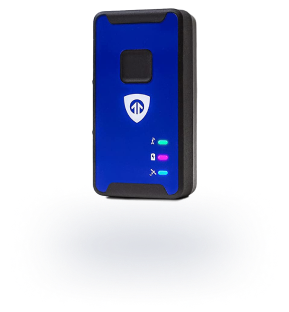
| Spark Nano 7 | Hidden placement anywhere on vehicle | Rechargeable battery + magnetic mount | Weatherproof, panic button, motion alerts |
| TrackPort OBD | Always-on tracking with no charging | Vehicle power via OBD-II port | Continuous power, instant setup, speed alerts |
Both trackers work with BrickHouse's tracking platform, which is accessible from any smartphone, tablet, or computer. Plans start at $17.99 per month with no contracts and no activation fees.
Frequently Asked Questions
Can I use an AirTag to track my car if it gets stolen?
You can try, but success depends entirely on whether iPhones pass near your stolen vehicle. In many theft scenarios, cars are moved to areas with low foot traffic (warehouses, rural lots, shipping containers), where AirTags stop updating entirely. Additionally, Apple's anti-stalking alerts will eventually notify the thief that an AirTag is present. A GPS tracker provides continuous real-time updates regardless of who is nearby and sends no alerts to third parties.
Do AirTags work without an iPhone nearby?
No. An AirTag has no ability to determine or report its own location independently. It can only be detected by nearby Apple devices participating in the Find My network. If no iPhone, iPad, or Mac passes within Bluetooth range (approximately 30 to 50 feet), the AirTag's location will not update.
Is a GPS tracker worth the monthly fee compared to a free AirTag?
It depends on what you are protecting. For keys and wallets, an AirTag is ideal. For a vehicle worth $20,000 or more, a teen driver's safety, or an elderly parent's wellbeing, the $17.99 per month provides real-time tracking, instant alerts, geofencing, and trip history that an AirTag simply cannot deliver. Most customers view it as inexpensive peace of mind.
Will a thief know there is a GPS tracker in my car?
Unlike AirTags, GPS trackers do not broadcast Bluetooth signals and do not trigger anti-stalking alerts on nearby phones. A magnetically mounted GPS tracker hidden under the chassis, inside a bumper, or behind interior panels is virtually undetectable without a physical search of the vehicle.
Can I track my car with an AirTag if I have an Android phone?
No. AirTags are designed exclusively for the Apple ecosystem. You need an iPhone to set up, manage, and track an AirTag through the Find My app. If you use Android, a GPS tracker is your only option for vehicle tracking, and it works equally well across all platforms.
How long does a GPS tracker battery last in a car?
Battery life depends on the device type and update frequency. The BrickHouse Spark Nano 7 lasts 2 to 4 weeks on a single charge with standard tracking intervals. OBD-II plug-in trackers like the TrackPort draw power directly from your vehicle's electrical system, so they never need charging and run indefinitely while the car's battery is connected.
The Bottom Line
AirTags and GPS trackers solve different problems. An AirTag is a $29 convenience tool for finding misplaced personal items in crowded areas. A GPS tracker is a security system that protects valuable assets, monitors loved ones, and provides real-time data you can act on immediately.
If you are reading this article because you are considering putting an AirTag in your car for theft protection, the honest answer is: it might work, but it probably will not when you need it most. A dedicated GPS tracker eliminates the guesswork entirely.
BrickHouse Security has provided GPS tracking solutions trusted by families, individuals, and law enforcement agencies since 2005, with over 31,000 verified customer reviews. Our trackers require no contracts, include free shipping, and come with a 30-day money-back guarantee.
Browse All GPS Trackers | See the Spark Nano 7
Not sure which tracker fits your situation? Contact our team for a free, personalized recommendation.
Posted by Todd Morris on Aug 6th 2024